Tell us about the job
Takes about a minute. No obligation.
A central AC compressor in this area spends its life waiting. Homes in Skagit County, WA have essentially no cooling season — no month of the year is warm enough to call for it. Sitting off-season is not rest: seals dry, contactors corrode, and capacitors weaken without the cycling that keeps them exercised. When a homeowner finally calls for a repair, the contractor is tracing faults that accumulated during the long off period, not wear from heavy summer runtime. That changes what gets inspected first: electrical components and refrigerant circuit integrity matter more here than compressor overload damage.
Ductwork in houses this old has typically served more than one system, and what accumulated inside it over those cycles is where a repair contractor spends time before touching the unit itself. Half the homes in Skagit County, Washington were built in 1986 or earlier (2020-2024 ACS 5-year). That depth of history in the housing stock means the components a technician pulls out once the system is open may come from a generation of equipment that manufacturers have since moved past, and sourcing parts for it becomes the job. A straightforward repair turns on whether the right parts are still made and where they ship from.
The Parts of a Central AC a Contractor Checks First
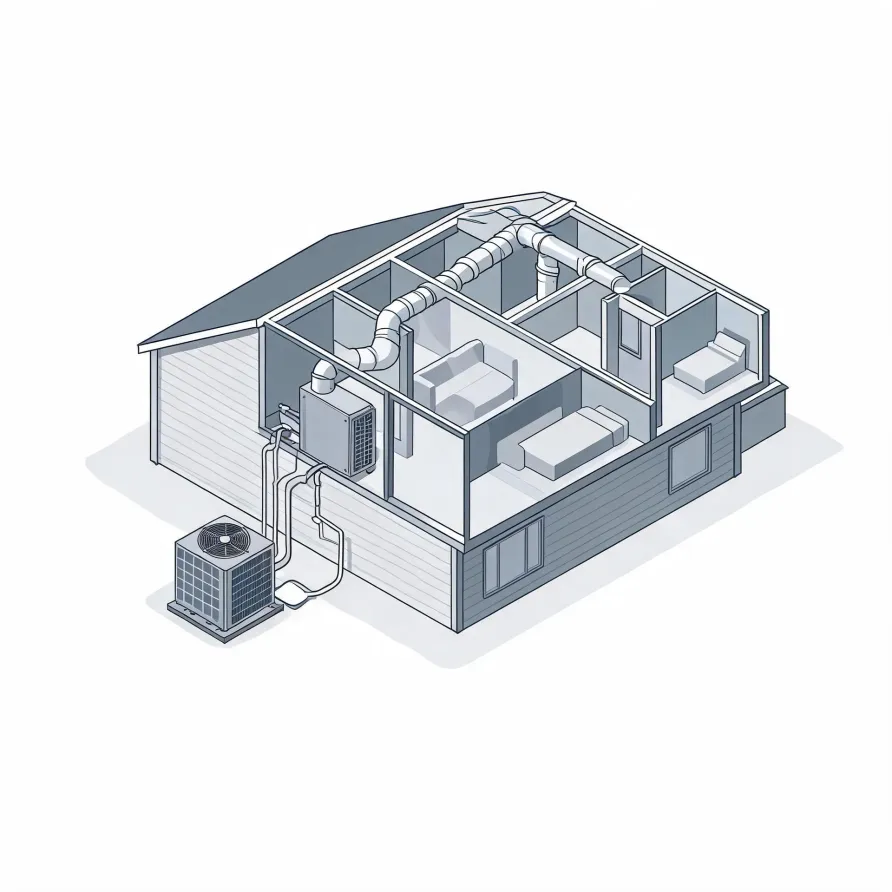
The outdoor condenser unit sits outside the house, usually on a concrete pad at ground level, and it carries the compressor and condenser coil. These are the pieces a contractor goes to first when a system stops cooling, runs but won't cycle off, or makes sounds it shouldn't. A failed compressor or a fouled coil will stop the whole system cold.
Inside the house, the air handler holds the evaporator coil and the blower fan, and it connects to the supply and return vents through the duct system. The expansion valve and refrigerant lines run between the two units. Weak airflow, ice on the coil, or warm air at the registers usually point back to something in this part of the system.
The drawing shows a typical layout, and a licensed contractor will determine which components and conditions apply to your specific home.
Get matched in Skagit CountySkagit County, by the numbers
Half the homes in Skagit County, Washington were built in 1986 or earlier (2020-2024 ACS 5-year).
U.S. Census Bureau, 2020-2024 American Community Survey 5-Year EstimatesSkagit County, Washington holds 57,050 housing units (2020-2024 ACS 5-year).
U.S. Census Bureau, 2020-2024 American Community Survey 5-Year EstimatesOwners occupy 70.1% of the occupied homes in Skagit County, Washington (2020-2024 ACS 5-year).
U.S. Census Bureau, 2020-2024 American Community Survey 5-Year EstimatesCodes & Standards Governing Central AC Repair in Skagit County, Washington9 sourced rules and standards
What happens when the contractor comes out
Split-system central air conditioners rated below 45,000 Btu/h manufactured on or after January 1, 2023 must meet a federal minimum of 13.4 SEER2.
Split-system central air conditioners rated at or above 45,000 Btu/h manufactured on or after January 1, 2023 must meet a federal minimum of 13.4 SEER2.
Split-system central air conditioners manufactured between January 1, 2015 and December 31, 2022 had to meet 13 SEER, the metric that preceded SEER2.
Single-package central air conditioners manufactured on or after January 1, 2023 must meet a federal minimum of 13.4 SEER2.
Space-constrained central air conditioners manufactured on or after January 1, 2023 must meet a federal minimum of 11.7 SEER2.
Federal efficiency standards for split-system central air conditioners and heat pumps are set on each certified combination of outdoor unit and indoor coil rather than on the outdoor unit alone.
Residential and light commercial air conditioning and heat pump systems assembled in the field, including mini-splits and unitary systems, may not be installed on or after January 1, 2025 using a refrigerant with a global warming potential above 700.
A field-assembled system whose specified components were all manufactured or imported before January 1, 2025 carries no installation compliance date under the refrigerant restrictions and may still be installed.
Licensing and Legal Requirements in Skagit County, Washington
Washington requires contractor registration rather than an HVAC licence: every contractor must register with the Department of Labor and Industries, and advertising, bidding or working as a contractor without that registration is a gross misdemeanour.